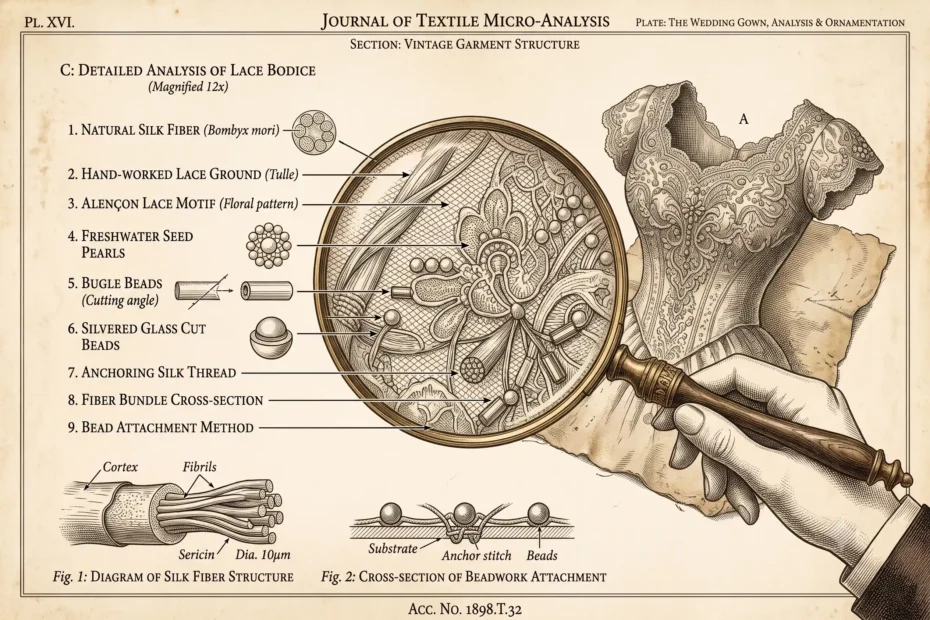
A vintage scientific illustration of the gown analysis process × NanoBanana3
You spent months choosing your gown. Now that the celebration is over, you are faced with a decision that feels surprisingly high-stakes: who do you trust to clean it, and how much should that trust actually cost?
If you are looking for the cheapest price in Metro Detroit, Janet Davis is likely not the right choice for you. We provide a level of care—and an honest assessment of risk—that comes with a premium. For some, that is exactly what they want; for others, it is more than they need.
Before you hand over your gown to anyone, you should understand what actually drives the cost of preservation and exactly what happens behind the scenes during the process. Most providers hide these details. We do not.
What Actually Drives the Cost of Preservation?
When you ask “how much,” you are really asking about value. In luxury garment care, price is not a flat fee; it is a reflection of the risk and labor involved in your specific gown.
There are four primary drivers that determine whether a preservation project is straightforward or highly complex:
1. Material Composition Not all fabrics are created equal. A polyester gown is resilient and predictable. A silk gown, however, is an entirely different conversation. Silk requires a more delicate touch and a more precise chemical balance; it is far less forgiving than synthetic blends, which increases the time and expertise required to treat it.
2. Embellishments and Volume The “size” of your gown isn’t just about the dress size—it’s about volume. A massive ballgown with a ten-foot train requires more cleaning solution, more labor to press, and a larger preservation chest. Furthermore, heavy beadwork, sequins, and intricate embroidery add layers of risk. These elements must be protected or stabilized before cleaning begins so they aren’t damaged in the process.
3. The Nature of the Stains Some stains are simple; others are aggressive. Removing red wine or blood often requires water-based treatments that can react poorly with certain fabric types. When a technician has to balance stain removal against fiber integrity, the labor increases significantly.
4. Existing Damage Dirt is not always just “dirt.” Under a microscope, hemline soil often looks like a 3D sawblade—jagged particles of grit and minerals that can actually slice through fibers. Sometimes, this dirt masks damage that already exists in the fabric. Identifying these risks during intake is what prevents a gown from being ruined during the cleaning process.
The Janet Davis Process: What’s Actually Involved?
Most brides drop their gown off at a counter and pick up a box three weeks later. They have no idea what happened in between. At Janet Davis, we follow a rigorous seven-step protocol to ensure that “preservation” isn’t just a word on a label, but a scientific process.
Step 1: Intake Consultation We do not accept gowns blindly. You meet with us to review the gown together. We document its current condition and confirm your expectations before a single drop of solvent touches the fabric. After meeting with you, we review everything and take photos of the gown to document it’s incoming condition.
Step 2: Preparation for Cleaning Our technicians test the fabric and beadwork to select the safest cleaning method. This stage often involves “pre-cleaning sewing”—carefully covering delicate beadwork or removing hoops and floral attachments to ensure they aren’t stressed during the wash.
Step 3: Pre-Spotting Treatment We do not rely on a machine to do the work. Every spot and stain is treated by hand. A technician spends unlimited time meticulously going over every inch of the gown to address specific stains before the general cleaning begins.
Step 4: Cleaning & Anti-Sugar Treatment The gown is cleaned using the method selected in Step 2. Crucially, this includes an anti-sugar treatment. This removes the microscopic sugars and proteins that are the primary cause of yellowing over time.
Step 5: Steaming & Pressing Because a preserved gown is ultimately folded into its chest, it does not need to be fully pressed. Instead, we lightly steam the garment to ensure all hard creases and wrinkles are removed. This prevents permanent set-in folds that can occur over decades of long-term storage, ensuring the fabric remains supple and smooth when eventually unfolded.
Step 6: Inspection & Reassembly We perform a final inspection to ensure every stain is gone and every fiber is sound. We reattach any details removed in Step 2, and we invite you back into the shop to view and approve your finished gown before it is boxed.
Step 7: The Preservation Chest The gown is packed into an acid-free and lignin-free chest using a bust form and acid-free tissue. We use white cotton gloves for every touch. Unlike many providers, we do not permanently seal the box (more on that below).
The Honest Truth About Risk
Here is the truth that most cleaners will not tell you: There is some level of risk in cleaning every single gown.
Whether it is a high-end specialist or a neighborhood dry cleaner, chemicals and moisture interact with fabrics in ways that aren’t always predictable. We believe in “no surprises.” During your intake, we will give you an honest assessment of the risks—even the low-probability ones.
For some brides, this honesty is frightening. For others, it is the only reason they trust us.
We recently had a bride bring in a very delicate gown with multiple risk factors: mixed materials, wine stains requiring water-based treatments, and fragile embellishments. After our honest assessment of how those variables interacted, she chose not to have her gown cleaned or processed. She decided that the risk of cleaning outweighed the benefit of removing the stains. We respected that decision because it was an informed one.
If you are not comfortable with any level of risk, the safest choice—regardless of who you hire—is to leave your gown as is.
How to Judge a Preservation Provider
When comparing options, do not look at the price tag first. Look at the standards. If you are considering a mail-order service or a budget provider, ask these three questions:
Can I see my gown before it is boxed? Many mail-order services return gowns already sealed. You have no way of knowing if the stains actually came out or if all the embellishments are still there until years later when you open the box. We invite you to approve the work in person or virtually, whichever is better for you.
Is the chest truly acid-free and lignin-free? “Acid-free” is a common claim, but “lignin-free” is the professional standard. Lignin is an organic polymer found in wood pulp that can re-acidify over time, causing the box itself to yellow your dress. We use only archival-grade materials.
Do they seal the box? Many providers preach permanent sealing to keep “bad things out.” Our position is the opposite: you never want to permanently seal a garment. While you want to prevent water intrusion, you must allow the gown and the box to breathe. Sealing can trap humidity and off-gassing inside, which accelerates deterioration. Our chests protect the gown while letting it breathe—with a viewing window so you can see it without opening the box.
A Fifth-Generation Standard
Garment care is not a commodity; it is a trade. Since 1938, our family has managed the delicate balance between cleaning efficacy and fabric preservation. As the current president of the Association of Wedding Gown Specialists (AWGS) and one of America’s Best Cleaners, we don’t just follow industry standards—we help set them.
When you entrust us with your gown, you aren’t paying for a box; you are paying for five generations of experience in knowing when to push, when to be cautious, and when to tell the truth.
Your Next Step
Because every gown is unique, we do not provide flat-rate pricing. To get an accurate assessment of your gown’s needs and a personalized quote, please visit our wedding gown preservation page.
Questions We Hear Often
When is the best time to have my gown cleaned and preserved?
Ideally within a few weeks of the wedding, as stains are most recoverable while they are fresh. However, we frequently work with gowns that arrive years after the ceremony. While older stains can be more difficult to lift due to oxidation, our restoration process is designed specifically to handle these challenges whenever possible.
Can you guarantee that all stains will come out?
We cannot. Some stains simply bond with the fiber more aggressively than others, and removing them entirely could risk damaging the fabric itself. We provide an honest assessment at intake so you know exactly what is achievable before we begin.
Is it safe to ship my gown to a preservation service?
Shipping introduces risks of crushing or moisture during transit. However, for those without access to a local specialist—particularly when seeking our advanced restoration services—we do accept mail-order gowns. The primary difference remains the verification: unlike many mail-order providers who seal the box before shipping it back, we ensure you have a way to verify the results of the work.
What does “acid-free” actually mean for my gown?
Standard cardboard and tissue contain acids that migrate into fabric over time, causing yellowing and brittleness (a process called acid hydrolysis). We use lignin-free materials, which ensure the packaging doesn’t re-acidify as it ages, keeping the gown in a chemically neutral environment.
Do I need to bring my veil or accessories for preservation?
We recommend bringing your veil and other fabric accessories; they often require different cleaning protocols due to their extreme fragility. However, do not include shoes in the preservation chest. Shoes contain glues and synthetic materials that off-gas over time, which can chemically damage your gown’s fibers. Store your shoes separately to keep them and your gown safe.