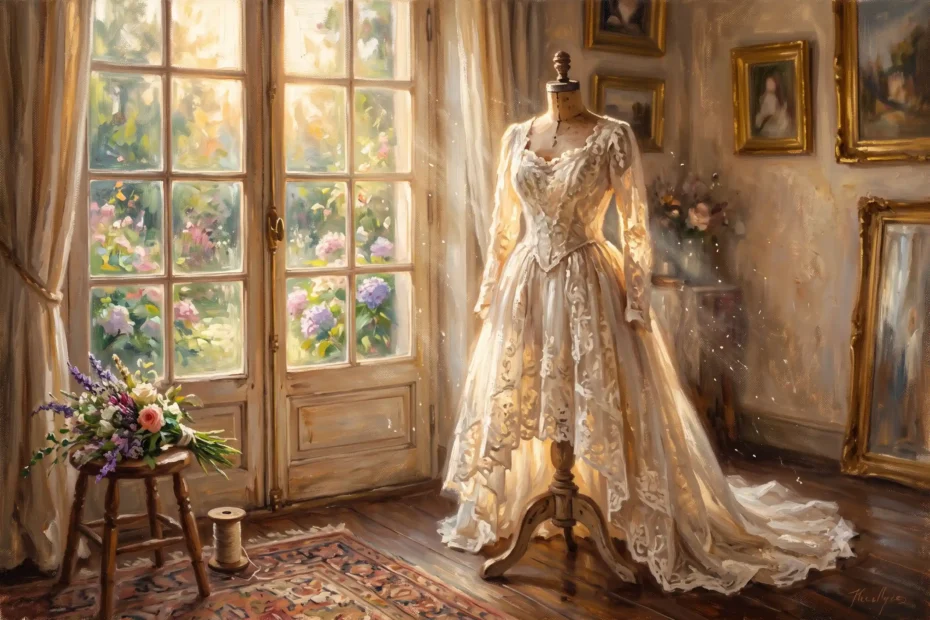
An Impressionist study of an heirloom gown in window light × NanoBanana3
You are holding a piece of family history. Whether it is your mother’s gown from the 1960s, a grandmother’s lace from the 40s, or a handmade treasure from an even earlier era, these garments carry more than just fabric—they carry memory.
The natural instinct when encountering yellowed silk, old stains, or the scent of decades-old storage is to want it restored to its original brilliance. The honest answer to whether that is possible is: sometimes.
At Janet Davis, we have performed hundreds of successful restorations. We have seen gowns recovered from basement floods and mold, and others that seemed lost to time. But we have also had to tell clients—including two women just last week—that their deceased mother’s gown was simply too frail to survive the process.
Restoration is not a standard cleaning service; it is a high-stakes collaboration between the specialist and the owner. This post will explain how we determine if a restoration is possible, what the actual craft involves, and why this process is fundamentally different from a trip to your neighborhood dry cleaner.
The Assessment: Determining if Restoration is Possible
Before a single drop of solvent touches an heirloom gown, we must determine if the garment is a candidate for restoration. In our experience, there are specific “tell-tale” signs that indicate whether a dress will survive the process in an acceptable manner.
During your intake consultation, we look at several critical risk factors:
- The Underarms: Due to natural body chemistry and acidity, the underarm area is typically the first part of a gown to degrade. If the fabric there is solid and intact, it is a strong signal that the rest of the dress can handle restoration.
- Moth Damage: We look for small holes. The presence of a few moth holes often indicates many more that are currently hidden by creases or stains; these usually become visible only after cleaning.
- Material Composition: Time acts differently on different textiles. Some synthetic blends from the mid-century hold up remarkably well, while certain silks can “shatter” or become brittle over time.
- The Hemline and Storage History: We examine how the gown was stored. Was it in a sealed plastic bag (which traps moisture) or a breathable chest? This history dictates our approach to removing ingrained grime from the hem.
If we determine that the fabric is too frail—meaning the risk of catastrophic failure outweighs the potential for improvement—we will tell you honestly and we will not move forward. We would rather deliver the disappointment of a “no” than the tragedy of a ruined heirloom.
The Craft: How Heirloom Restoration Actually Works
Heirloom restoration at Janet Davis is a highly hands-on process. Unlike routine garment cleaning, restoration is approached one piece at a time, with the treatment dictated by the garment—not by a standard cleaning cycle or a promised turnaround date.
The goal is not simply to make an old garment “clean.” It is to carefully reverse as much yellowing, oxidation, staining, and age-related discoloration as the textile will safely allow while preserving the original fabric, trims, beadwork, lace, and construction.
The process follows these specific stages:
1. The Intake Consultation
Restoration begins with understanding what we are working with.
You meet with Kyle or another experienced specialist at our Metro Detroit facility, where we examine the garment closely and talk through its history, current condition, and your expectations for the restoration.
We look for more than visible stains. Age can affect different parts of a garment in very different ways. Fabrics may have yellowed unevenly, old spills may have oxidized, lace may have darkened, metal components may have corroded, and previously invisible stains can become dramatically more noticeable after decades in storage.
That initial evaluation helps us determine what may be recoverable—and where the garment requires extra caution.
2. Preparation (The Invisible Armor)
Before full treatment begins, we test discreet areas of the garment to learn how the fabric, dyes, trims, and embellishments respond.
Vintage textiles rarely come with complete information about their fiber content, previous cleaning history, or everything they have been exposed to during their lifetime. Testing helps us determine which restoration techniques can be used safely and where treatment must be modified.
We may also perform protective sewing before cleaning. Fragile beadwork can be temporarily covered, loose trims stabilized, and flowers, bows, hoops, or other components carefully removed when necessary. Their exact locations are documented so they can be returned to their original positions later.
3. Hand Pre-Spotting
Every restoration is carefully worked by hand before the garment undergoes its primary cleaning treatment.
We examine the textile section by section, identifying visible stains as well as the brown or yellow oxidation marks that often develop from old food, beverages, perspiration, body oils, or environmental exposure.
These stains may have been present for decades, and they rarely respond to a single treatment. Different stains require different chemistry, and treatment may need to be repeated gradually to improve the appearance without unnecessarily stressing weakened fibers.
This is one of the most important differences between cleaning and restoration: we are not simply removing today’s soil—we are trying to reverse decades of chemical change in the textile.
4. The Manual Cleaning
Once testing and preliminary stain treatment are complete, the garment receives the cleaning and restoration treatment determined to be safest for that particular textile.
For many heirloom pieces, this is where the most dramatic transformation occurs. Specialized restoration processes can gradually lift generalized yellowing and oxidation that ordinary cleaning cannot remove.
The garment is continually evaluated throughout the process. Restoration is rarely a matter of putting a dress into a machine and waiting for a cycle to finish. Treatment may be adjusted, repeated, or stopped depending on how the fabric responds.
Our objective is always improvement without sacrificing the integrity of the garment simply to make it appear whiter.
5. Steaming and Stabilization
After cleaning and restoration are complete, the garment is carefully inspected to evaluate the results and identify anything that still requires attention.
This inspection is important because restoration can reveal details that were difficult to see beneath decades of yellowing or discoloration. We examine the fabric, lace, seams, trims, embellishments, and previously stained areas to make sure the garment has responded as expected and that no additional treatment is appropriate.
The garment is then carefully steamed to relax wrinkles and restore its shape. On fragile heirloom textiles, finishing is performed with the same caution as cleaning—using only as much heat, moisture, and handling as the fabric can safely tolerate.
6. Final Inspection and Reassembly
Any flowers, bows, trims, hoops, or embellishments removed during preparation are returned to their documented original positions. Temporary protective coverings and basting stitches are removed, and the garment is assembled as it was intended to be.
We then conduct a final inspection, looking at the garment as a whole as well as the individual details.
The goal of restoration is not to make an antique garment look artificially new. It is to recover as much of its original beauty as the textile will safely allow while preserving the fabric, construction, craftsmanship, and history that make it an heirloom in the first place.
The Risks: Why You Should Never “DIY” an Heirloom
When people realize that professional restoration is expensive and time-consuming, they sometimes consider attempting it at home in a bathtub or large bucket. This is the most dangerous choice you can make with a vintage garment.
The danger isn’t usually in the initial soak—it’s in the “speedbumps.” When an unexpected reaction occurs—a dye bleed, a fabric tear, or a chemical stain—only decades of experience can steer that problem toward a successful outcome. The wrong move during a DIY attempt often causes catastrophic, irreversible damage to vintage fibers.
Similarly, standard neighborhood dry cleaners are rarely equipped for this work. Most will flatly refuse the job; those who don’t may apply industrial processes that are too aggressive for 60-year-old silk. We are willing to attempt restorations that others walk away from because we have honed a process designed specifically for fragility.
Is Heirloom Restoration Right for You?
Because this work is done by hand, one dress at a time, it requires two things: an investment in cost and an investment in time. A proper restoration typically takes 12 to 16 weeks.
This process is not the right choice if:
- You are on a tight deadline (e.g., you need the dress for a wedding next month).
- You are looking for a “cheap refresh” rather than professional conservation.
- You are unable to accept the inherent risk of vintage work. While we are extremely careful, we did not manufacture the original garment nor control its storage for the last several decades; therefore, we cannot guarantee a 100% perfect outcome.
For those who value the history of the piece over the speed of the process, restoration is the only way to ensure an heirloom survives another fifty years.
A Fifth-Generation Perspective on Preservation
Janet Davis Cleaners has been caring for garments since 1938. That gives us a perspective few textile care companies can offer: we worked on many of today’s “vintage” garments when styles and fabrics like them were still new. We have also preserved gowns within our own families and seen firsthand how properly cared-for textiles hold up over decades.
Our commitment to long-term garment care is also reflected in the professional organizations we choose to be part of. Janet Davis Cleaners has been a member of the Association of Wedding Gown Specialists (AWGS) since 2006, an international network of cleaners specializing in wedding gown cleaning, restoration, and preservation. We are also an affiliate of America’s Best Cleaners, a select organization of textile care professionals focused on exceptional craftsmanship, advanced cleaning techniques, and continuing education.
Together, those relationships give us access to a broader community of specialists and decades of shared knowledge about what works—and what can go wrong—when caring for garments meant to last for generations.
That experience has taught us an important lesson: restoration can accomplish remarkable things, but the best outcome is to prevent severe deterioration in the first place.
After an heirloom has been restored, proper preservation and storage help protect it from the same forces that caused the damage—residual stains, oxidation, light, moisture, improper packaging, and years of uncontrolled storage.
Whether it is a wedding gown being saved for a daughter or granddaughter, a christening gown worn by three generations, or another meaningful family textile, preservation is ultimately an act of stewardship. The goal is not simply to make the garment look beautiful today. It is to give the next generation the opportunity to experience it too.
If you have an heirloom gown and aren’t sure if it can be saved, your next step is to let us see it.
Visit our Vintage Garment Restoration page to get more information, request a rough online estimate, or find instructions for shipping your gown to our facility if you are outside of Metro Detroit.
Questions We Hear Often
Is an appointment necessary to drop off my gown?
No appointment is required. Our operating hours are Monday through Friday, 7 am–6 pm, and Saturdays from 9 am–3 pm. Please allow about 30 minutes for the initial intake consultation so we can review the garment together.
Can I ship my gown to you from out of town?
Yes. We accept shipments from all over the country. When shipping, please insure the package for the full value of the gown and include your contact information. You will need to be available via email to sign and return our required paperwork before work begins.
Can you provide a firm price quote before I bring it in?
We can provide an approximate estimate (see our Wedding Gown Price Estimator) based on your web form submission, but the final price is determined only after a physical inspection. Factors like specific fabric types (such as silk), designer construction, and the level of restoration needed will influence the final cost.
Can you repair tears or replace missing beads?
In many cases, yes. Members of our team can handle minor sewing repairs, such as securing loose trim, repairing small tears, or replacing missing beads and ornamentation when appropriate. If a repair is beyond what we can safely perform in-house, we will recommend that you work with an outside seamstress or specialist. We can discuss any repair needs during your intake inspection.
Is a deposit required for restoration work?
Yes. Because of the intensive manual labor and time involved, a 50% deposit is required at the time of drop-off (or upon receipt of signed paperwork for shipped items).