You likely spent months choosing your gown, and now that the celebration is over, you are faced with a decision that feels deceptively simple: do you hang the dress in your closet, or do you have it professionally boxed?
If you plan to wear your gown again within a few months—perhaps for an anniversary shoot or a second event—hanging is perfectly acceptable. However, if you choose this route, there is one non-negotiable rule: never store a gown while it is still dirty. Invisible stains from perspiration or champagne oxidize over time; what looks clean today can become a permanent yellow stain in six months. If professional preservation isn’t your current goal, our cleaning and steaming services are the proper way to ensure the garment remains viable for future use.
To be clear: Janet Davis is not the right choice for someone who simply wants a dress “put away” for a few weeks. But if you are looking to protect an heirloom for twenty or fifty years, there is a fundamental difference between storage and preservation.
The structural risk of hanging long-term
Many brides assume that because a gown comes with hanger loops, it was meant to be hung forever. In reality, those loops are for short-term convenience during wedding preparations.
When a gown hangs for years, gravity becomes its primary enemy. A wedding dress is often heavy—weighted down by intricate beadwork, layers of tulle, and structured bodices. Over time, that weight pulls relentlessly on the shoulder seams and straps.
While it isn’t every day we see this failure, it happens when a day turns into a week, which turns into a year, which eventually turns into twenty. We have seen gowns where the underarms and side seams are literally splitting because the fabric was not strong enough to withstand decades of tension. In some cases, the silk or satin has been stretched so thin that it can no longer be sewn or repaired. Once the structural integrity is compromised by gravity, the damage is often permanent.
Preservation box vs. bag: Understanding the difference
There is a significant gap between putting a dress in a garment bag and placing it in a preservation chest.
A garment bag—even a high-quality one—is designed for transport and short-term protection against dust. It does nothing to stop the chemical processes that cause yellowing, nor does it alleviate the structural stress of hanging.
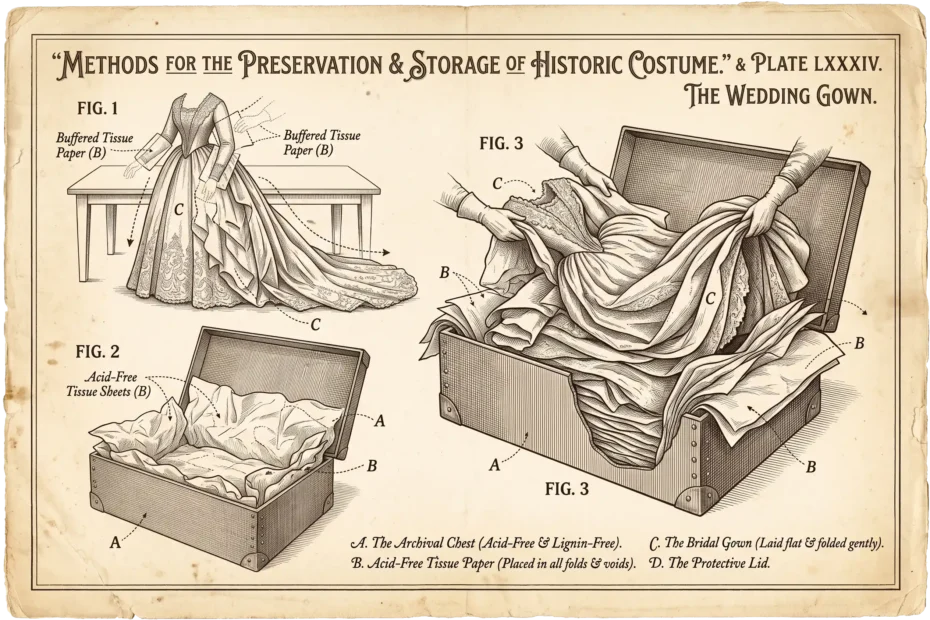
Professional preservation is an end-to-end system of care. The boxing process only begins once the gown has been properly cleaned and steamed. At Janet Davis, this sequence is deliberate:
- Verification: Two separate team members verify that all pieces—including the gown and any detachable accessories like sleeves—are accounted for before the garment ever touches the box.
- Material Selection: We use preservation chests from Foster-Stephens, chosen specifically because their paper formulations meet professional archival standards. These are not simply pH neutral; they are acid-free textiles designed to protect heirlooms over decades.
- The “Set”: The gown is carefully placed using acid-free tissue paper at every fold and throughout the interior to prevent permanent creasing and fabric-on-fabric friction.
- Labeling and Protection: Once positioned—ideally with the bodice facing the viewing window—the box is labeled with our guarantees, then wrapped in muslin for final protection.
The danger of plastic and vacuum sealing
If you are considering a DIY approach, you may be tempted by plastic storage bins or vacuum-seal bags. From a specialist’s perspective, these are some of the most risky choices you can make.
Does plastic ruin a gown long term?
Yes. Many plastics “off-gas” chemicals as they age, which can react with the fibers of your gown and accelerate yellowing. Furthermore, plastic traps moisture. If there is any residual humidity or an invisible stain left on the fabric, the plastic creates a greenhouse effect that encourages mold and mildew to grow.
Do vacuum seal bags wrinkle a dress?
They do more than wrinkle it; they can crush it. Vacuum sealing removes all air, forcing the fabric into tight, unnatural folds. For gowns with structured bodices or delicate beadwork, this pressure can permanently distort the shape of the garment and crack fragile embellishments. Once a gown has been crushed under vacuum pressure for years, restoring its original loft and silhouette is an uphill battle.
The “Sealing” Myth: Why we let your gown breathe
There is a common industry practice where cleaners seal their preservation boxes airtight with tape around all the edges. They claim this “locks out oxygen.”
We deliberately do not do this.
Fully sealing a chest traps moisture and contaminants inside with your gown. The cardboard of a professional preservation chest is designed to be slightly porous; it allows the garment to breathe while still keeping dust out. More importantly, we believe in transparency. A sealed box prevents you from verifying the condition of your gown. We encourage our clients to open their chests periodically to inspect their gowns (provided you use the gloves we provide and avoid touching the fabric with bare skin).
How to judge a preservation service
If you are comparing providers, do not look at the price alone—look at the materials and the guarantee. Many budget cleaners use “acid-free” boxes, but they overlook lignin. Lignin is a natural component of wood pulp found in cheap paper; if it isn’t removed (making the box “lignin-free”), the box itself will eventually turn yellow and transfer that acidity to your dress.
A professional preservation service should be able to tell you:
- Exactly what their boxes are made of (and who makes them).
- How they handle folds to prevent permanent creasing.
- Why they do or do not seal the box.
- What specific treatments they use to remove “invisible” sugars and perspiration that cause yellowing over time.
At Janet Davis, our commitment is backed by a lifetime guarantee against yellowing and creases within our archival chests—a standard supported by the Association of Wedding Gown Specialists.
A fifth-generation standard
The science of preservation has evolved since we opened in 1938, but the core principle remains: stewardship. Whether it is our current anti-sugar cleaning standards or our partnership with Foster-Stephens for archival chests, every detail is designed to ensure that when you open that box in thirty years, the gown looks as though it were just finished on the press today.
If you are ready to move your gown from short-term storage into long-term preservation, we invite you to use our specialized tools to determine the best path for your garment.
Next Step: Use our wedding gown pricing tool to see the options available for your specific gown’s needs.
Questions We Hear Often
What happens if I already hung my dress for a few years?
Bring it in as soon as possible. We do not simply move an older, hung garment into a chest; we perform our entire Preservation service. This allows us to inspect the seams for stress and determine if structural repairs are needed before cleaning and boxing the gown to prevent further degradation.
What is typically included in a full preservation package?
Our comprehensive service covers everything from expert cleaning and professional pressing or steaming to meticulous white-glove handling. This includes the cleaning and steaming of one standard wedding veil at no additional charge, as well as the careful inspection and boxing of detachable accessories like sleeves.
How long does it take for a gown to be fully preserved?
To maintain our multi-step cleaning and archival standards, the process typically takes three months. We provide an estimated completion date at drop-off; however, we can occasionally accelerate this timeline for emergencies on a case-by-case basis if slots are available.
Can I just use a plastic bin if it’s in a cool, dry place?
Even in a climate-controlled room, plastic is not archival. It can off-gas and trap moisture against the fabric, which leads to yellowing and potential mildew. A lignin-free preservation chest is the only way to ensure chemical stability over decades.
Is there any time when hanging is better than boxing?
Yes—for short-term storage (a few months) or for permanent display. If you wish to showcase your gown, we offer a “Mrs. Case” option specifically designed for safe, long-term hanging and display.
Will folding the dress in a box cause permanent creases?
Not when done correctly. We use acid-free tissue paper at every fold to support the fabric and prevent “hard” creases from forming. This is why professional boxing is superior to simply folding a dress into a bin.